
A guide for freelancers and studios
Client intake questions that help you start well
A good intake form does one job: it gives you enough to have a useful first conversation. Ask too little and the first call is admin. Ask too much and good clients stop halfway. Here’s how to choose the questions, word them and decide which ones really need an answer.

Start with a short set
If you only ask five things, ask these. They tell you who is asking, what they want, and whether the timing and money could work. Everything else can wait for the call.
- What should we call you?
- What’s the best email to reach you?
- What would you like to make?
- When would you like it ready?
- Roughly what budget do you have in mind?
What each question is for
Every question should earn its place. If you can’t say what you’ll do with an answer, leave the question out. Mark a question required only when you truly can’t reply without it.
| Topic | Question | Why it helps | Required? |
|---|---|---|---|
| Who | What should we call you? | A name turns your reply into a conversation. | Yes |
| Contact | What’s the best email to reach you? | You need somewhere to send your reply. | Yes |
| Goal | What would you like to make? | A few clear choices show at a glance whether it’s your kind of project. | Yes |
| Situation | What do you have already? | An existing site, brand or plan changes where the work starts. | No |
| Outcome | What would make this a success for you? | It gives you their words for the result, which you can repeat back later. | No |
| Scope | Is there anything you know you don’t want? | Ruling things out is often easier than describing them. | No |
| Timing | When would you like it ready? | A rough date tells you straight away whether you can help. | No |
| Budget | Roughly what budget do you have in mind? | A few ranges are easier to answer than an empty box. | No |
| Decisions | Who else will help decide? | You learn early if someone else needs to see the proposal. | No |
Ask the follow-up only when it applies
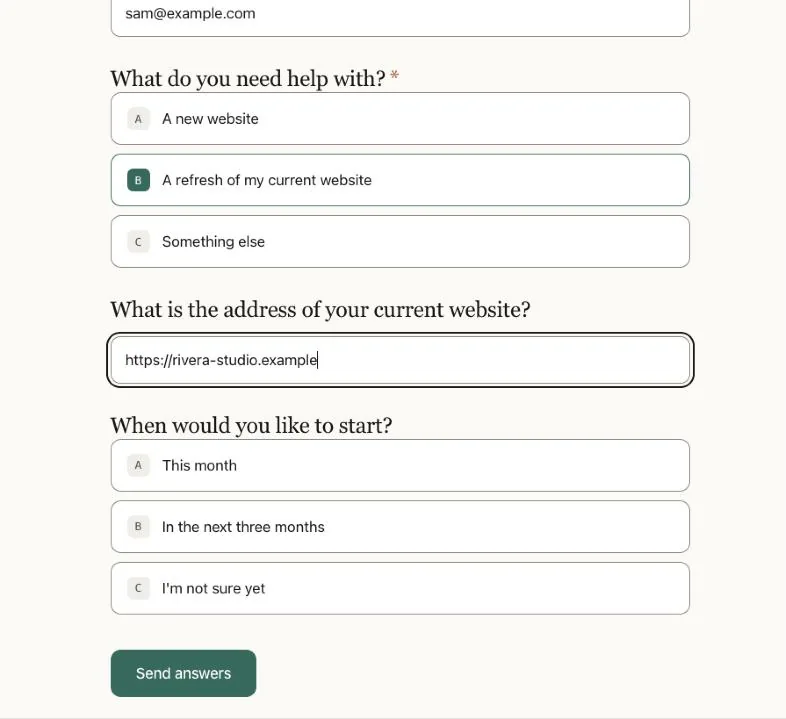
Some questions only make sense for some people. Asking for the address of a current website is pointless if the client is starting from scratch. A rule lets that question appear only when it’s relevant, so everyone else sees a shorter form.
In Formaverse, under the follow-up question, choose Show when, pick the question and the answer it depends on, then press Done. In the example below, the website question appears only after someone chooses “A refresh of my current website”.
A short version and a longer one
For a first enquiry from your website, keep it short: the five questions above are plenty. Once you’ve spoken and the project looks likely, send a second, longer intake form with the situation, outcome, scope and decision questions. People are happier to answer more once they know you.
A worked example
Here is an invented brief, built from the answers to the short set and two optional questions.
Sam runs a small pottery studio and wants a refresh of their current website. They’d like it ready in the next three months and have a modest budget. Success, in their words, is “people can book a class without emailing me”. They don’t want an online shop yet.
That is enough for a good first call. You know the starting point, the deadline, the money and the single outcome that matters, and you know not to pitch a shop.
Mistakes to avoid
- Asking for a phone number, address or date of birth you don’t need. Ask only for what you’ll use.
- Making every question required. A required budget question can stop a good client who simply isn’t sure yet.
- Writing jargon. “What does success look like?” is clearer than “Define your KPIs.”
- Putting the hardest question first. Start with something easy, like a name.
What Formaverse doesn’t do yet
- Each form is separate. Moving from a short enquiry to a longer intake form is a step you take yourself, by sending the second form’s link.
Next step
Try the client intake exampleKeep reading

Client project intake
A good project starts with a little understanding.

Conditional logic
Show the right next question, and skip the rest.

Question types
Every kind of answer, one slash away.
That idea in your head?
Give it a form.
You bring the curiosity. We’ll bring the checkboxes.
Make something, freeFree to start. Yours to make.