
A guide for small teams
Customer feedback questions you can act on
Feedback is only useful if it helps you decide something. Start with the decision, ask a few neutral questions, and keep the form short enough that people actually finish it.

Start with the decision
Before you write a question, finish this sentence: “When the answers come back, we’ll decide whether to…”. Keep the format of a workshop? Change how you hand over a project? Answer emails faster? The decision tells you which questions matter and which are just curiosity.
Three short sets to start from
Pick the set that matches the moment, then cut anything that doesn’t serve your decision.
After a recent interaction, such as a call or a support reply: how easy was it to get what you needed, and is there anything we could have done better?
After a completed project: how useful was the result, which part of working together helped most, and what one thing would you change next time?
About the overall experience: how likely are you to work with us again, what do you value most, and what nearly made you choose someone else?
Weak wording and better wording
Leading questions get polite answers. Neutral questions get useful ones.
| Weak | Better | Why |
|---|---|---|
| How great was our workshop? | How useful was the workshop for your work? | “Great” suggests the answer. “Useful” asks for a judgement. |
| Did you like the slides and the exercises? | Which part helped you most? | One question, one idea. Two ideas in one question give an answer you can’t read. |
| Any feedback? | What one thing would you change for the next session? | A specific, small ask is easier to answer than an empty box. |
| Would you recommend us to everyone you know? | How likely are you to work with us again? | Ask about their own behaviour, not an imagined crowd. |
Scales, written answers and follow-ups
Formaverse has a star rating and a scale from 0 to 10. Use one scale per form if you can, so the numbers are easy to compare. Say in the question what the scale is about, such as “How useful was the workshop for your work?”, rather than “Rate us”.
Make written answers optional. Some people have a lot to say and some don’t, and a required text box mostly collects “n/a”.
A follow-up can ask why only when it helps. For example, after “Did you get what you needed?”, show “What got in the way?” only to people who choose “Not quite”. Keep the follow-up neutral and short.
From answers to one change
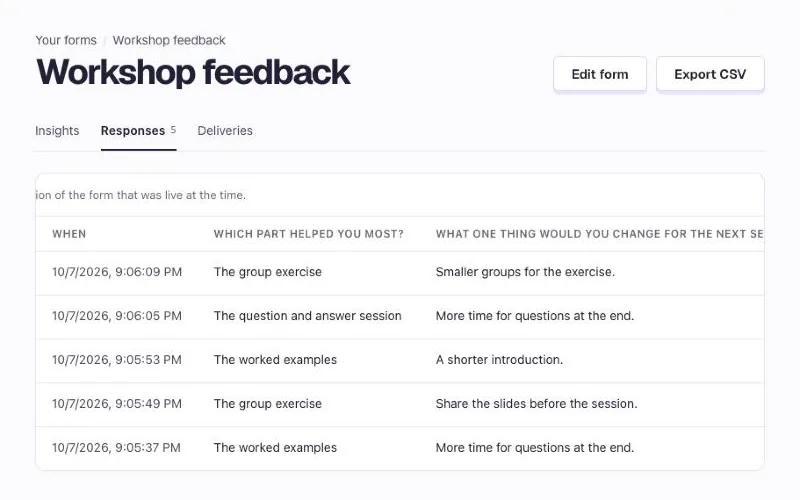
Here is a small, invented set of five responses to a workshop feedback form. Two people chose the worked examples as most helpful, two chose the group exercise and one chose the question and answer session. Two people, separately, asked for more time for questions at the end.
Five answers don’t prove anything about everyone who came, so treat them as a prompt, not a verdict. A sensible next step is to try one change: leave ten more minutes for questions next time, then ask the same questions again and see whether the comments move.
When to ask, and how much
- Ask soon after the moment, while it’s fresh: the same day for a workshop, within a week for a project.
- Keep it to three or four questions. Every extra question asks a little more of people, and some will stop before the end.
- Put the most important question first, in case people stop early.
- Say how long it takes and what you’ll do with the answers.
- Remember who answered. People who reply are not always typical of everyone you serve.
Next step
Try the feedback exampleKeep reading

Customer feedback
Make it easy for people to tell you what could be better.

Course feedback
The best course is the next one.

Responses and insights
See what people said, and where they stopped.
That idea in your head?
Give it a form.
You bring the curiosity. We’ll bring the checkboxes.
Make something, freeFree to start. Yours to make.